

I still remember the first time someone asked me “so what exactly do you do?” and I froze for a second before saying, “I get websites to show up on Google.” That answer was true, but it was also the most oversimplified version of a job that actually touches strategy, writing, technical fixes, patience, and a fair amount of trial and error. Years later, running SEO for clients across two very different markets, Pakistan and the US, I still find myself explaining SEO to beginners almost weekly. So I wanted to write the guide I wish someone had handed me on day one, minus the jargon, plus the stuff that only becomes obvious once you have actually done it.
What Is SEO, Really?
SEO stands for Search Engine Optimization, and at its core it is the practice of shaping a website so that search engines like Google understand it, trust it, and show it to the right people at the right moment. That is the textbook definition. My personal definition, after years of watching traffic graphs rise and fall, is simpler: SEO is the ongoing work of making sure your website answers a question better than everyone else answering the same question.
When I started, I thought SEO was mostly about keywords. Stuff a page with the right words, and Google rewards you. That idea is outdated now, and honestly it was already fading a decade ago. Today’s search engines are far more interested in whether your content actually helps the person who typed the query, whether your site loads fast, whether it feels trustworthy, and whether other credible sources vouch for you.
How Search Engines Actually Work (The Part Most Guides Rush Through)
Before I understood ranking, I had to understand the three-step process search engines use behind the scenes: crawling, indexing, and ranking. I explain this to every new client because once you get this, half of SEO stops feeling like magic.
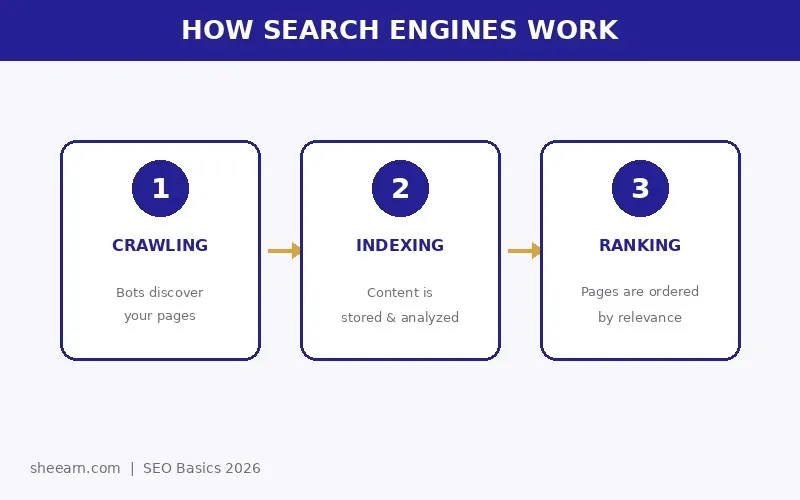
- Crawling: Google sends automated bots, often called spiders, that follow links across the web to discover new and updated pages. If your page has no links pointing to it and is not submitted anywhere, it may never get found.
- Indexing: Once a page is crawled, Google analyzes its content, images, and structure, then stores it in a massive database called the index. A page that is not indexed cannot appear in search results, no matter how good it is.
- Ranking: When someone searches a query, Google’s algorithm sorts every relevant indexed page using hundreds of signals, then decides the order they appear in.
Here is the thing nobody tells beginners: most SEO problems live in step one or two, not step three. I have had clients obsess over ranking factors while their new blog posts were not even getting indexed. Fixing indexing issues alone has doubled traffic for pages that were technically “invisible” for months.
On-Page vs Off-Page SEO: The Two Halves of the Puzzle
Early in my career I treated these as separate disciplines. Now I see them as two sides of the same coin, working together rather than competing for attention.
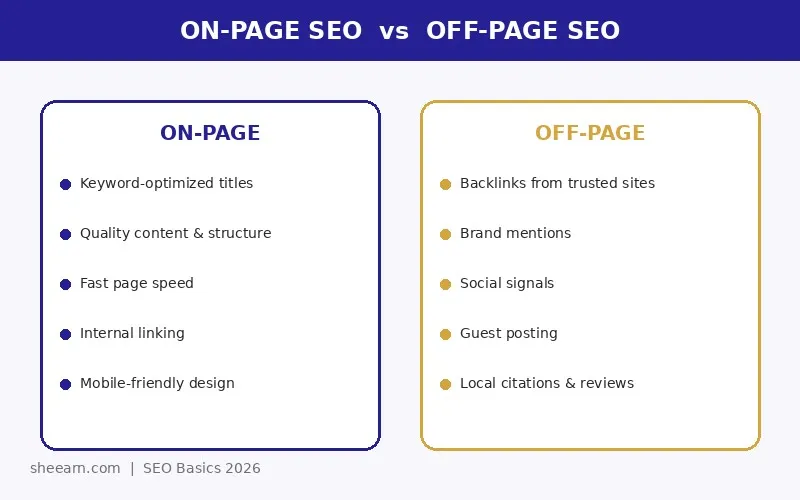
On-page SEO is everything you control directly on your website: your titles, your headings, your content quality, your page speed, your internal linking, and how mobile-friendly your pages are. This is where I spend most of my early-stage work with new clients because it is the foundation everything else builds on.
Off-page SEO is what happens beyond your own site: backlinks from other websites, brand mentions, social signals, and citations if you are a local business. Off-page work is slower and harder to control, which is exactly why so many beginners avoid it, even though it is often what separates a page stuck on page two from one sitting at the top of page one.
A pattern I have noticed across both Pakistani and American markets is that businesses tend to over-invest in one side and ignore the other. A gorgeous, technically perfect website with zero backlinks struggles just as much as a site with hundreds of backlinks but thin, unhelpful content.
The SEO Timeline Nobody Wants to Hear About
If there is one conversation I have had more than any other, it is managing expectations around timing. Clients want rankings in two weeks. SEO rarely works that way, and I would rather be honest about it upfront than have someone feel misled three months in.
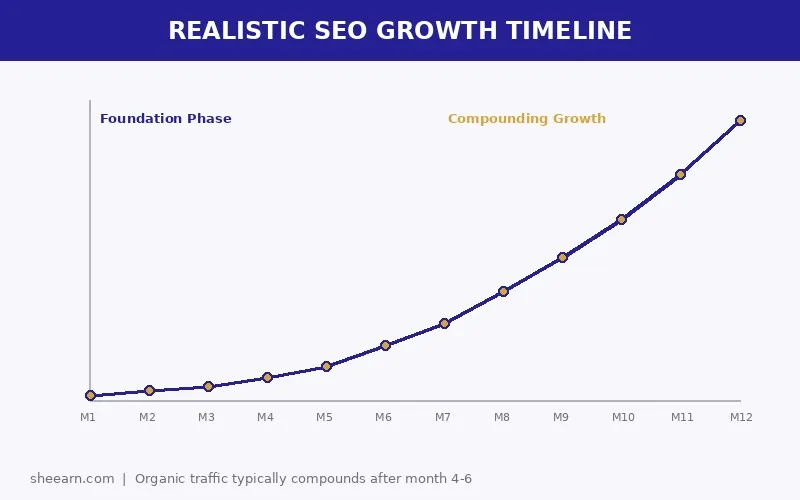
In my experience, the first three to four months are what I call the foundation phase. You are fixing technical issues, publishing consistently, building early links, and Google is still figuring out how much to trust your site. Growth during this window is usually slow and can even look flat on a graph. Then, somewhere around month four to six, if the foundation work was solid, growth starts compounding. Pages that were sitting in positions fifteen to twenty climb into the top ten, and traffic starts curving upward instead of crawling along the bottom.
I have watched this pattern repeat across dozens of sites, and the businesses that quit at month two almost always miss the payoff that was two months away.
What I Actually Prioritize in 2026
Search has changed a lot even in the last couple of years, and here is what genuinely moves the needle in my day-to-day work right now:
- Search intent matching matters more than exact keyword matching. Google increasingly rewards content that satisfies why someone searched, not just what they typed.
- Helpful, experience-based content is being rewarded over generic, AI-sounding filler. Google’s Helpful Content systems specifically look for signals of real expertise and firsthand experience.
- Page experience and speed still quietly influence rankings, especially on mobile, where most traffic now originates.
- Striking distance keywords, meaning terms already ranking in positions five through twenty in Search Console, are consistently the fastest wins available. I check these before almost anything else on a new client account.
- Local and long-tail phrasing, structured as service plus audience plus location, continues to outperform broad head terms in competitive markets, particularly for smaller or newer sites that cannot yet compete for high-volume generic terms.
A Few Honest Lessons From the Trenches
If I could go back and tell myself three things when I started, they would be these. First, technical SEO is not optional, even if content feels more exciting to work on; a fast, crawlable, well-structured site is the floor everything else stands on. Second, consistency beats intensity; five well-researched articles published steadily over five months will usually outperform fifty rushed ones published in a single week. Third, and this took me the longest to accept, not every ranking drop is a penalty. Algorithms update constantly, and a temporary dip is often just noise, not a crisis.
Where This Leaves You as a Beginner
SEO is not a trick and it is not instant, but it is also not as mysterious as it is often made out to be. It is the steady work of helping search engines find your site, understand it, and trust it enough to recommend it to the right people. Start with the fundamentals: make sure your pages are indexable, write content that genuinely answers your reader’s question, keep your site fast and mobile-friendly, and be patient enough to let the compounding growth phase actually arrive.
That patience, more than any single tactic, has been the real differentiator in every successful campaign I have run.
