
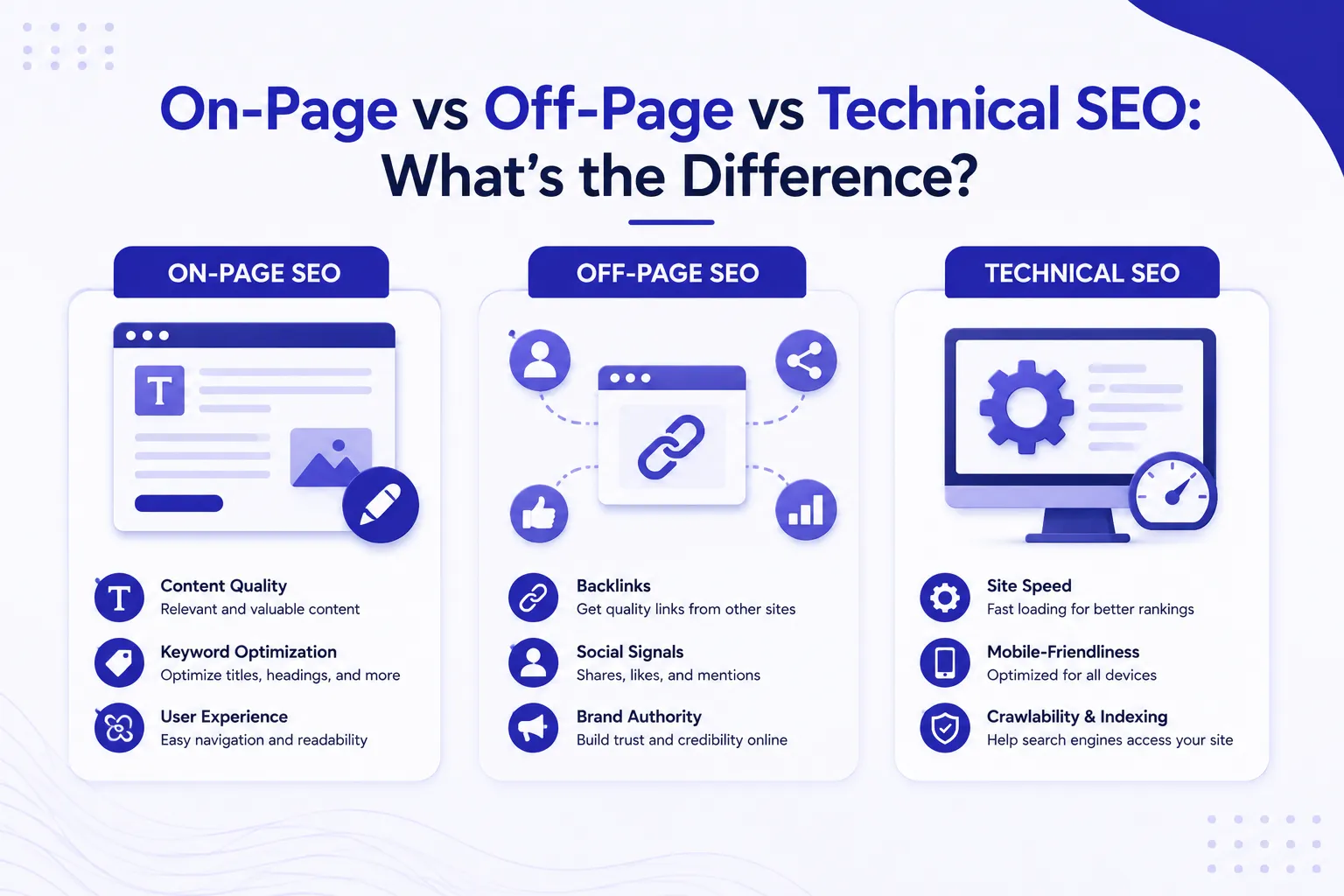

Every few weeks a client sends me a message that goes something like, “our developer said the site is technically fine, so why aren’t we ranking?” It is a fair question, and it usually comes from a place where SEO has been treated as one single task rather than three distinct, interlocking disciplines. Once people understand that on-page, off-page, and technical SEO are separate levers, each doing a different job, the whole picture starts making a lot more sense.
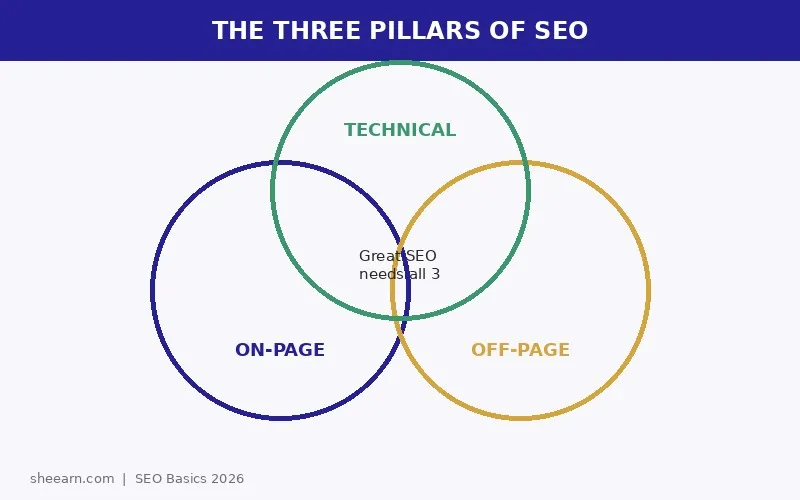
Here is how I explain it, drawn from years of watching all three work together, and occasionally watching what happens when one of them is ignored.
On-Page SEO: What You Control on the Page Itself
On-page SEO covers everything that lives directly on a specific page and that you, as the site owner, have full control over. This includes your titles, headings, body content, keyword placement, internal links, and image alt text.
I think of on-page work as the conversation happening between your content and the person reading it. A well-optimized page answers the searcher’s question clearly, uses natural language around the topic rather than forced keyword repetition, and guides the reader toward a next step, whether that is a purchase, a signup, or reading a related article. When I audit a page, I am checking whether the title actually reflects what someone searching that term wants, whether headings break the content into scannable sections, and whether internal links connect related pages in a way that makes sense to both readers and search engines.
The mistake I see most often here is treating on-page SEO as a checklist rather than a craft. Cramming a keyword into every paragraph does not help anymore; it actively works against you. Good on-page SEO reads like it was written for a human first, because it was.
Off-Page SEO: What Happens Beyond Your Website
Off-page SEO is everything that builds your site’s reputation from the outside: backlinks from other websites, brand mentions, social signals, and for local businesses, reviews and citations across directories.
This is the part of SEO that feels the least controllable, and that is exactly why it matters so much. Anyone can write a well-structured page about their own business. Far fewer businesses can earn a genuine link from a respected industry site, a mention in a local news article, or a strong cluster of positive reviews. Search engines treat these signals as a kind of third-party vote of confidence, essentially other corners of the internet vouching for you.
In my experience, off-page work is also the slowest to show results, and the easiest for beginners to underinvest in. A site can have flawless on-page content and still stall in rankings simply because nothing outside the site is reinforcing its credibility.
Technical SEO: The Foundation Everything Else Sits On
Technical SEO is the plumbing. It covers site speed, mobile-friendliness, secure connections, clean URL structures, proper indexing, and making sure search engine bots can actually crawl your site without hitting dead ends or broken pathways.
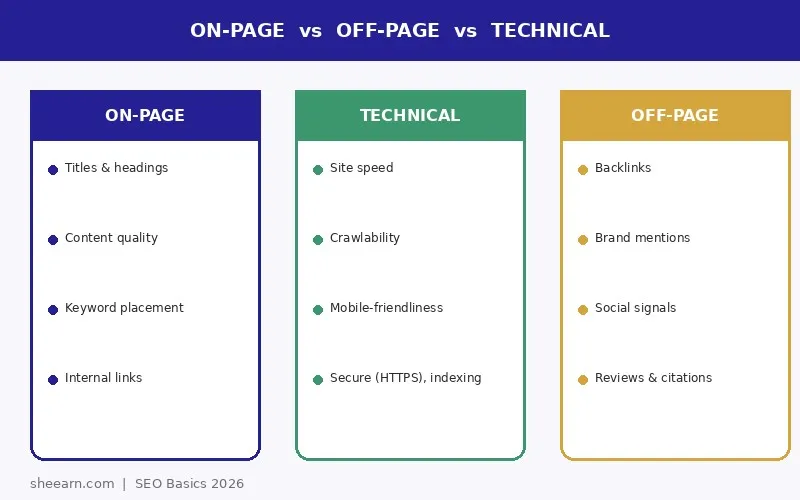
This is the layer I check first on any new project, before touching a single word of content. Here is why: I have seen beautifully written pages sit completely unranked because a misconfigured setting was blocking search engines from indexing them. I have seen fast-loading, technically sound sites recover rankings within weeks simply by fixing crawl errors that had gone unnoticed for months. Technical SEO does not usually get the credit it deserves because it is invisible when done right, and only obvious when something breaks.
Putting Them Side by Side
Seeing all three next to each other tends to make the differences click faster than any explanation on its own.
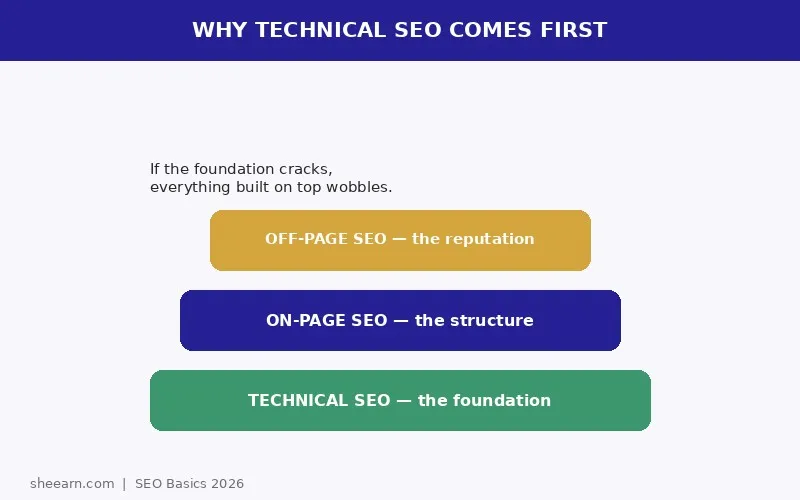
- On-page SEO answers the question: does this specific page communicate clearly to both the reader and the search engine?
- Off-page SEO answers the question: does the rest of the internet trust and vouch for this site?
- Technical SEO answers the question: can search engines even access, read, and understand this site in the first place?
Notice that each question depends on a different kind of effort. On-page is largely a writing and structuring skill. Off-page is a relationship and reputation-building skill. Technical is closer to engineering. That is precisely why one person or one tactic rarely covers all three well, and why sites that only focus on one tend to plateau.
Which One Should You Prioritize First?
If I am starting fresh with a new site, I always begin with technical SEO. There is no point writing excellent content or chasing backlinks if search engines cannot properly crawl and index the pages in the first place. Once the technical foundation is solid, on-page work becomes the next priority, since it is the layer you have the most direct control over and can improve immediately. Off-page work runs alongside both, but it tends to compound more slowly and benefits from having strong on-page content worth linking to in the first place.
A pattern I have noticed across client sites in both Pakistan and the US is that businesses often invest heavily in one pillar while quietly neglecting another. A gorgeous, fast, technically flawless site with thin or generic content will not outrank a slower site that genuinely answers the searcher’s question better. Equally, incredible content sitting on a site riddled with technical errors may never get seen at all.
The Real Takeaway
On-page, off-page, and technical SEO are not competing strategies, they are three different jobs that all need to be done for search engines to find, trust, and rank your site. Technical SEO opens the door. On-page SEO makes sure what is behind that door is worth reading. Off-page SEO convinces the rest of the internet to point people toward that door in the first place. Skip any one of them, and the other two end up working twice as hard to compensate.




Hi, this is a comment.
To get started with moderating, editing, and deleting comments, please visit the Comments screen in the dashboard.
Commenter avatars come from Gravatar.