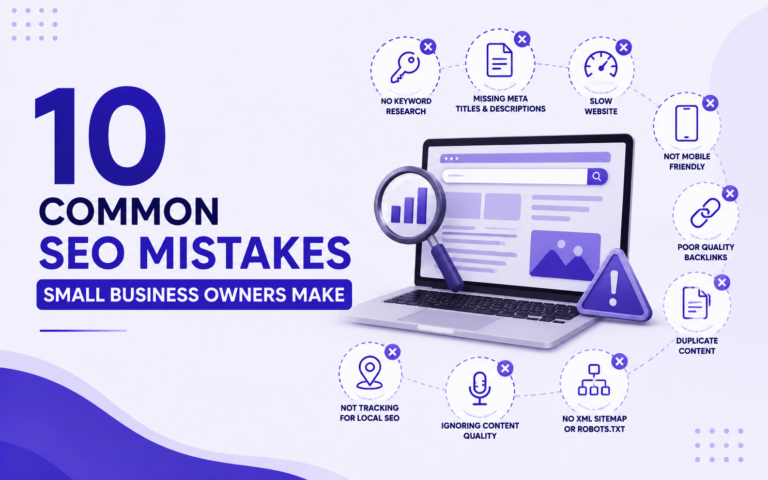
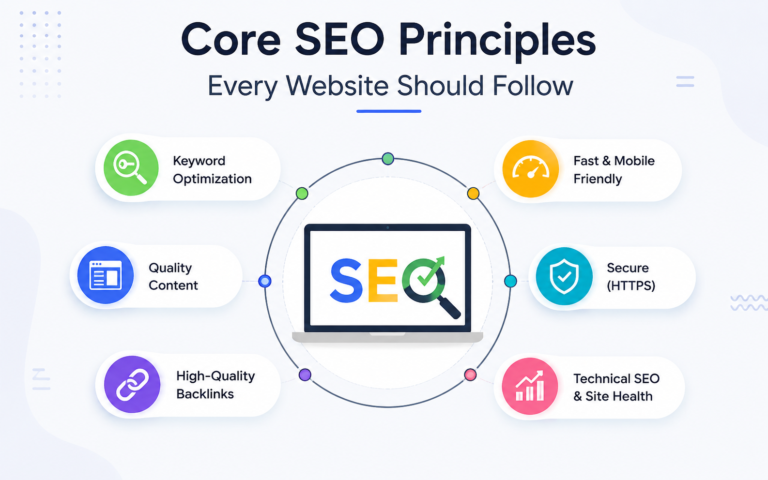
Yes, SEO is still worth learning in 2026. Organic search drives over 53% of all website traffic globally, and demand for skilled SEO professionals continues to grow on both local job boards and international freelance platforms. What has changed is which SEO skills are in demand. Strategic, intent-led optimization has replaced keyword stuffing as the core competency.
This guide gives you the complete answer: what changed, what the career actually pays in Pakistan and globally, how AI fits into the picture, and exactly how to go from zero to your first paid SEO work.
The Short Answer: Is SEO Worth Learning in 2026?
SEO is worth learning in 2026 for one simple reason: every business with a website needs organic traffic, and organic traffic requires SEO. That demand has not weakened. What has shifted is the definition of the skill itself.
What “Learning SEO” Actually Means in 2026
Learning SEO in 2015 meant memorizing keyword density rules, building as many backlinks as possible, and stuffing exact-match phrases into page titles. None of that approach survives contact with Google’s current algorithm.
Learning SEO in 2026 means understanding:
- Search intent: why someone types a query and what content format satisfies it
- Technical site health: whether Google can crawl, index, and render your pages correctly
- Topical authority: how to build a content structure that signals expertise across an entire subject area
- E-E-A-T: demonstrating Experience, Expertise, Authoritativeness, and Trustworthiness through content and site signals
- Analytics interpretation: reading Search Console and GA4 data to find and act on ranking opportunities
The skill floor has risen. The income ceiling has risen with it.
SEO in 2026 vs. SEO in 2015
| SEO in 2015 | SEO in 2026 | |
|---|---|---|
| Core skill | Keyword placement and link volume | Search intent matching and topical authority |
| Content approach | Thin pages targeting exact-match keywords | Comprehensive content clusters |
| Technical focus | Meta tags and basic site speed | Core Web Vitals, indexation, structured data |
| AI involvement | None | Content assistance, not content replacement |
| Career demand | Emerging | Established and growing |
| Pakistan opportunity | Limited | Strong via remote work and freelancing |
Is SEO Dead? The History of That Question
Every major Google update since 2011 has produced a wave of “SEO is dead” content. The pattern is consistent, and so is the outcome.
Every Time Someone Declared SEO Dead and What Happened Next
- 2011 — Google Panda: “Content farms and SEO are finished.” Result: thin, low-quality content was penalized. Well-written, substantive content ranked higher than ever.
- 2012 — Google Penguin: “Link building is over.” Result: paid and spammy links were devalued. Genuinely earned links became more powerful.
- 2016 — RankBrain: “AI will replace SEOs.” Result: semantic search understanding improved. SEOs who understood user intent thrived; those optimizing for exact-match phrases struggled.
- 2019 — BERT: “Keywords don’t matter anymore.” Result: keyword strategy evolved into intent matching. The skill did not disappear. It upgraded.
- 2023 — ChatGPT: “AI will replace SEO entirely.” Result: AI-generated content flooded the web. Google responded with stricter quality signals. Strategic SEO became more valuable, not less.
- 2024 — Google AI Overviews: “Zero-click searches will kill SEO.” Result: sites with strong E-E-A-T signals were featured inside AI Overviews, generating a new category of visibility.
The Pattern Every “SEO Is Dead” Moment Follows
Each update on that list did the same thing: it punished low-skill SEO and rewarded strategic SEO.
The people declaring SEO dead were, in almost every case, practitioners whose specific low-effort tactic had stopped working. The skill itself did not die. The shortcut did.
This matters because it tells you exactly what kind of SEO to learn: the strategic, fundamentals-based kind that survives algorithm updates rather than the loophole-chasing kind that depends on them. If you want to see what that looks like in practice, the She Earn approach to SEO is built entirely around this principle.
What AI Actually Does to SEO
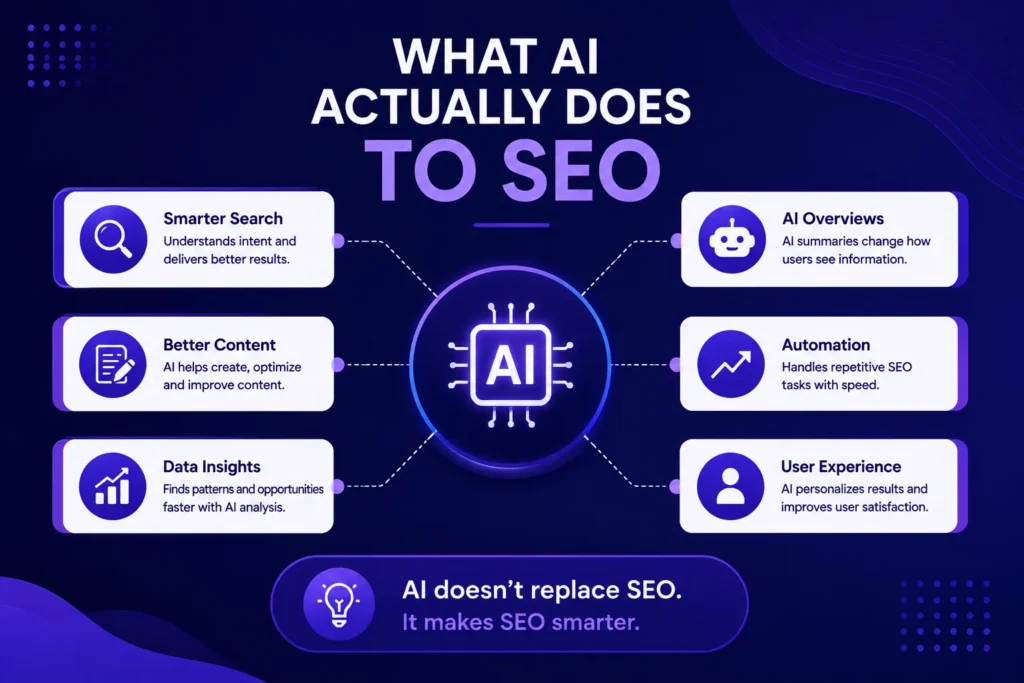
This is the question most guides get wrong in 2026. The honest answer is not “AI will replace SEO” and it is not “AI changes nothing.” The accurate answer is more specific: AI is automating the lowest-skill SEO tasks while simultaneously increasing demand for SEOs who can think strategically.
Which SEO Tasks AI Is Replacing Right Now
| SEO Task | AI Impact | What This Means for You |
|---|---|---|
| Writing generic meta titles and descriptions | High, largely automated | Learn the strategy behind them, not just the execution |
| Producing thin informational content | High, commoditized | Focus on expert-led, experience-backed content |
| Basic keyword research | Medium, tools surface data faster | Your job is to interpret data, not collect it |
| Technical SEO audits | Medium, crawlers automate detection | Implementation still requires a human |
| Search intent analysis | Low, still requires human judgment | High-value skill to develop now |
| Link building and outreach | Low, relationships cannot be automated | Durable, hard-to-replace skill |
| Content strategy and topical authority | Low, requires business and audience context | Highest-value SEO skill in 2026 |
Why AI Overviews Make Branded SEO More Important, Not Less
Google’s AI Overviews pull their answers from sources that demonstrate strong E-E-A-T signals: sites with clear authorship, depth of coverage, and established topical authority. A site with no SEO foundation is invisible to both traditional organic search and AI-generated answer panels.
The practical implication: if you want your business or content to appear inside AI Overviews, you need better SEO, not less of it.
The SEO Skills That Become More Valuable as AI Automates the Rest
As AI handles repetitive, low-judgment tasks, these skills become the differentiator:
- Strategic intent mapping: understanding the full search journey behind a keyword, not just its monthly volume
- Topical authority architecture: structuring content so Google recognizes a site as a subject expert
- Technical SEO diagnosis: identifying and fixing crawlability, indexation, and Core Web Vitals issues
- Local SEO: especially in underserved markets like Bahawalpur, Karachi, and Lahore where Google Business Profile optimization outperforms most other tactics at the early stage
- E-E-A-T signaling: building the on-site and off-site signals that tell Google a source is trustworthy
The Career Case for Learning SEO in 2026
The income potential of SEO is not theoretical. It is one of the few digital skills where a practitioner in Pakistan can earn in US dollars from home, with no capital investment beyond a laptop, and with results demonstrable to clients within 90 days.
What SEO Jobs and Freelance Work Actually Pay
| Market | Entry Level | Mid Level | Senior / Specialist |
|---|---|---|---|
| Pakistan (local market) | PKR 40,000 to 70,000/month | PKR 80,000 to 150,000/month | PKR 180,000+/month |
| Pakistan (remote, USD clients) | $300 to $600/month | $700 to $1,500/month | $2,000 to $5,000+/month |
| USA (full-time employment) | $45,000 to $60,000/year | $65,000 to $90,000/year | $100,000+/year |
| Freelance (global platforms) | $15 to $25/hour | $30 to $60/hour | $75 to $150+/hour |
Why SEO Is Especially High-ROI for Students in Pakistan
SEO has a specific advantage for Pakistani learners that most career guides do not address directly:
- Zero capital requirement. You do not need a studio, equipment, or software license to start. A free Google Search Console account and a practice website costing under $20 per year are enough to build a real portfolio.
- No portfolio gatekeeping. Unlike graphic design or development, SEO results are measurable and verifiable. A screenshot of a keyword moving from position 34 to position 6 is a client-ready case study.
- USD income without relocation. Platforms like Upwork, Fiverr, and LinkedIn connect Pakistani SEOs directly to US and European clients. The currency gap between PKR and USD means even modest freelance rates translate to competitive local income.
- Faster path to income than most tech skills. Web development and UI/UX design require 12 to 18 months of learning before most practitioners are marketable. A focused SEO learner working through a structured curriculum like the She Earn SEO courses can land a first paid project in 3 to 6 months.
SEO vs. Other Digital Marketing Skills: Which to Learn First
| Skill | Time to First Income | Income Ceiling | Demand in Pakistan | Remote Work Potential |
|---|---|---|---|---|
| SEO | 3 to 6 months | Very high | Growing fast | Very high |
| Social media marketing | 1 to 2 months | Medium | Saturated | Medium |
| PPC / Google Ads | 2 to 3 months | High | Medium | High |
| Content writing | 1 to 2 months | Medium | Saturated | High |
| Email marketing | 3 to 4 months | Medium | Low | High |
| Web development | 6 to 12 months | Very high | High | Very high |
SEO sits at the intersection of high income ceiling and accessible entry point. It also compounds. An SEO who adds content strategy, technical auditing, or local SEO to their skillset does not start over. They stack.
What an SEO Career Path Looks Like From Beginner to Specialist
- Months 1 to 2: Learn SEO fundamentals: search intent, on-page optimization, keyword research, and technical basics using free resources including Google Search Central, Ahrefs’ beginner course, and Moz’s guide.
- Months 2 to 3: Build a practice site on any topic you know well. Publish 5 to 10 pieces of properly optimized content. Connect it to Google Search Console and start reading the data.
- Months 3 to 4: Offer a free audit to a local business, a friend’s site, or a nonprofit. Document the before state with screenshots. Implement recommendations. Track changes.
- Months 4 to 6: Land your first paid project via Fiverr, Upwork, or a local referral. Charge modestly. Deliver results. Get a written testimonial.
- Months 6 to 9: Choose a specialization: local SEO, e-commerce SEO, or technical SEO. Build 2 to 3 case studies with ranking data showing measurable improvement.
- Month 9 onward: Move to retainer clients for predictable monthly income, or apply for agency or in-house SEO roles with a portfolio behind you.
How to Learn SEO in 2026: The Right Order
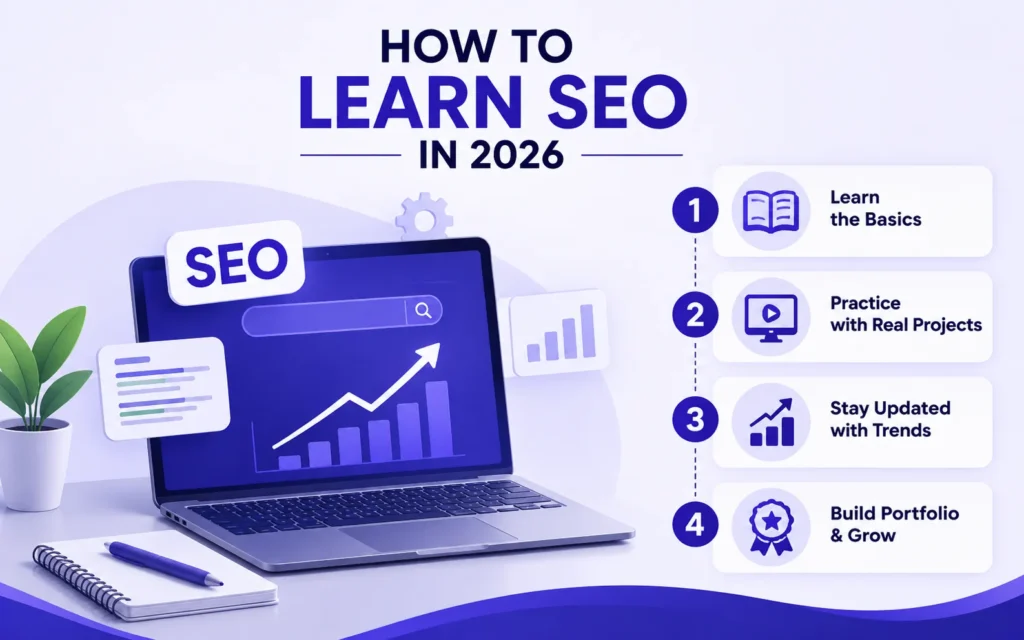
Most people learn SEO in the wrong order. They start with link building or keyword tools before they understand why search engines rank pages at all. The sequence below fixes that.
The Skills to Learn First, Second, and Third
- Search intent and keyword research: before you optimize a single page, understand what the person typing a query actually wants to find, and whether the content format they expect is a blog post, a service page, a video, or a product listing.
- On-page SEO: title tags, H1 and H2 structure, meta descriptions, URL slugs, image alt text, and internal linking. These are the controllable signals on every page you publish.
- Technical SEO basics: crawlability, indexation, site speed, Core Web Vitals, and mobile optimization. A technically broken site cannot rank regardless of content quality.
- Content strategy: how to plan topic clusters rather than isolated pages. A site that covers a subject comprehensively outranks a site with one strong post on the same topic.
- Link building and authority: earning backlinks, building local citations, and developing E-E-A-T signals that tell Google the site is trustworthy and authoritative.
- Analytics and Search Console: reading data, tracking keyword rankings, identifying pages stuck in striking distance positions (5 to 20), and making optimization decisions based on evidence.
Free vs. Paid Resources: What Is Actually Worth Your Time
| Resource | Cost | Best For |
|---|---|---|
| Google Search Central documentation | Free | Technical SEO fundamentals, straight from the source |
| Ahrefs SEO course for beginners | Free | Keyword research and on-page basics |
| Moz Beginner’s Guide to SEO | Free | Complete foundational overview |
| She Earn SEO courses | Affordable | Pakistan-context learning with structured progression |
| Semrush Academy | Free | Tool-specific certifications |
| Agency internship or mentorship | Varies | Hands-on work with real client sites |
The One Mistake That Wastes Months of Learning Time
Most beginners spend three to four months consuming SEO tutorials, blog posts, and YouTube videos before touching a real website. That approach builds recognition. You can identify SEO concepts when you see them. But it does not build skill.
SEO is only learned through execution. You need a live website receiving real Google traffic before you can understand how rankings move, why pages stall, and how changes produce measurable outcomes.
The fastest path is a practice site from week one, not week twelve. Pick any topic you know something about, buy a domain, publish five properly structured posts, and connect it to Search Console. Every concept you read about will become concrete the moment you see it happen on your own site.
Is SEO Worth Learning for Your Specific Situation?
The answer depends on where you are starting from. Here is the direct answer for each common scenario.
If You Are a Student in Pakistan With No Tech Background
Yes. SEO has the lowest barrier to entry of any high-earning digital skill. It does not require coding ability, design skills, or a degree. The learning resources are free. The tools at beginner level are free. The only investment required is consistent time over 3 to 6 months.
Students in cities like Bahawalpur, where access to formal digital marketing education is limited, have particularly strong upside. Local SEO expertise in Bahawalpur is undersupplied relative to the number of small businesses that need it.
If You Already Know Social Media or Content Writing
Yes, and your existing skills accelerate the return. A content writer who understands SEO: keyword targeting, search intent, on-page structure, internal linking, can charge 2 to 3 times more per project than a writer who does not. SEO does not replace your current skill. It multiplies it.
If You Want Remote Work With USD Income
SEO is one of the clearest paths from Pakistan to USD-denominated remote income without visa requirements, relocation, or a large upfront investment. Client results are verifiable, which means trust builds faster than in creative fields where quality is subjective. To understand what professional SEO delivery looks like at a service level, reviewing what a full-service SEO agency actually covers gives you a clear picture of what clients pay for.
If You Are a Business Owner, Not a Jobseeker
Understanding SEO fundamentals, even at a strategic level without executing it yourself, gives you three practical advantages:
- You can evaluate whether an agency’s work is actually moving rankings or just producing reports
- You can brief writers and content teams to produce pages that search engines can understand
- You can identify whether the traffic your site receives matches the customers your business actually wants
Business owners who understand SEO spend their marketing budget more efficiently than those who do not. If you want professional SEO done for your business rather than learning it yourself, the She Earn team is available to discuss your goals.
SEO Learning Checklist for 2026
Use this checklist to track your progress from beginner to job-ready SEO practitioner.
Foundation Knowledge
- Understand how Google crawls, indexes, and ranks pages
- Know the four types of search intent: informational, navigational, commercial, transactional
- Understand what E-E-A-T is and why Google uses it
- Know the difference between on-page, off-page, and technical SEO
- Understand what Core Web Vitals measure and why they matter
Practical Skills to Build
- Conduct keyword research and identify search intent before writing any page
- Write and optimize a title tag, meta description, H1, and URL slug correctly
- Run a technical audit using Google Search Console and identify crawl errors
- Build a content cluster with a pillar page and at least three supporting posts
- Set up and interpret a basic rank tracking report
Tools to Learn
- Google Search Console (free, non-negotiable starting point)
- Google Analytics 4 (free, traffic and user behavior data)
- Ahrefs Webmaster Tools or Ubersuggest (free tier, keyword and backlink data)
- Screaming Frog SEO Spider (free up to 500 URLs, technical site auditing)
Frequently Asked Questions About Learning SEO in 2026
Is SEO a Good Career in Pakistan in 2026?
Yes. Pakistani SEO professionals working with international clients on platforms like Upwork and Fiverr earn between $300 and $1,500 per month at entry to mid level, with senior specialists reaching $2,000 to $5,000 per month. Local market salaries range from PKR 40,000 to PKR 180,000 depending on experience. Demand is growing as more Pakistani businesses in cities like Karachi, Lahore, Islamabad, and Bahawalpur invest in digital visibility and remote employers seek affordable, skilled SEO talent.
How Long Does It Take to Learn SEO From Scratch?
A focused learner working consistently can land a first paid SEO project within 3 to 6 months. Reaching mid-level competency, where you can independently manage a client’s SEO strategy and report on results, takes 12 to 18 months of active practice on real websites. The variable that matters most is not how much content you consume but how early you start working on a live site with real Search Console data.
Will AI Replace SEO Professionals?
AI is replacing specific low-skill SEO tasks: writing generic meta descriptions, producing thin informational content, and running basic keyword lists. It is not replacing the strategic layer of SEO: search intent analysis, topical authority planning, technical site diagnosis, and link acquisition. Practitioners who focus on those strategic skills are becoming more valuable as AI floods the web with low-quality content that Google actively filters out.
Is SEO Better Than Social Media Marketing as a Career?
For income ceiling and long-term stability, SEO has the stronger case. SEO results compound over time. A well-ranked page continues generating traffic without ongoing spend. Social media requires constant content output to maintain reach, and organic reach on most platforms has declined steadily. SEO also has a higher remote work demand and a clearer path to USD income for Pakistani freelancers. Social media marketing has a faster path to first income but a lower ceiling and more competition at the entry level.
Can I Learn SEO for Free?
Yes. Google Search Central, Ahrefs’ free beginner course, and Moz’s Beginner’s Guide to SEO together cover the full foundational curriculum at no cost. Semrush Academy offers free certifications. The limitation of free resources is structure. They do not tell you what to learn in which order, and they do not address Pakistan-specific market context like local freelance rates, Google Business Profile optimization for Urdu-language markets, or how to position yourself on international platforms. The She Earn courses are built specifically to close that gap.
Start Here, Not Somewhere Else
Every principle in this guide points to the same conclusion: SEO is a skill with growing demand, a rising income ceiling, and a clear path from beginner to paid practitioner. The question is not whether it is worth learning. It is whether you start this week or spend another month watching tutorials without touching a site.
Pick a topic, register a domain, connect it to Google Search Console, and publish your first properly optimized page. The learning that happens on a live site in one month outpaces six months of passive consumption.
If you want a structured path through that process, with Pakistan-market context, live feedback, and a curriculum built around getting real results, explore She Earn’s SEO courses or get in touch with the team to discuss done-for-you SEO services.