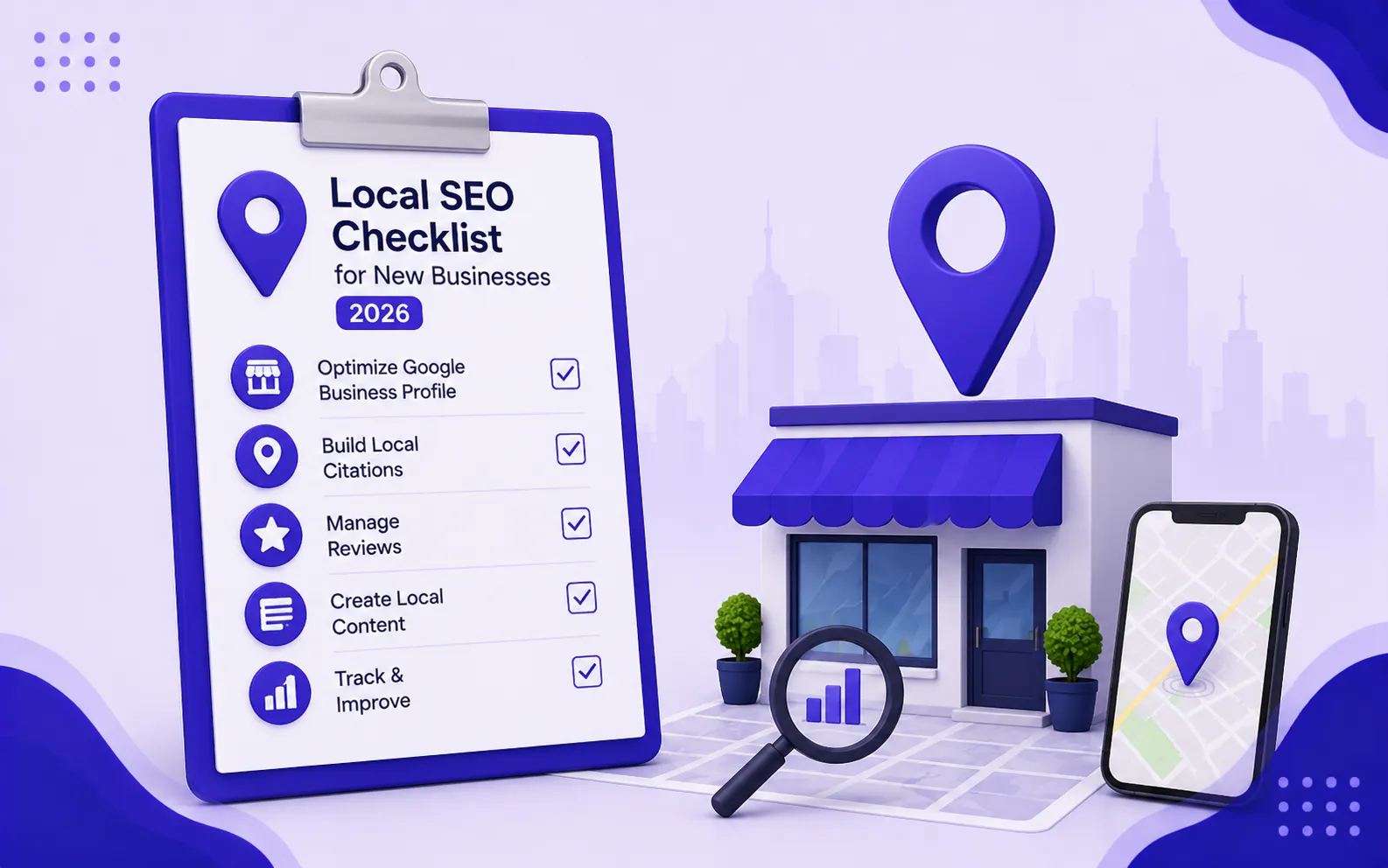

A new business that gets local SEO right from day one builds search visibility significantly faster than one that waits six months and then tries to fix a broken foundation. This checklist covers every local SEO action a new business needs to complete, in the correct order, from claiming your Google Business Profile to publishing your first city-specific content. Each item is actionable, specific, and sequenced so that each step builds on the one before it.
Whether you are launching a business in Bahawalpur, Karachi, Lahore, or a US city like Charlotte or Dallas, the framework is the same. The competitive intensity and timelines differ by market, but the checklist does not.
How to Use This Checklist
Work through the four phases in order. Do not skip to content or link building before your technical foundation and Google Business Profile are in place. Local SEO compounds: each completed item strengthens the items that follow it. A GBP profile optimized before citations are built gets more value from those citations. Citations built before your website NAP is consistent waste effort.
| Phase | Focus | Timeline |
|---|---|---|
| Phase 1 | Google Business Profile setup and optimization | Week 1 |
| Phase 2 | Website local SEO foundation | Weeks 1 to 2 |
| Phase 3 | Citation building and NAP consistency | Weeks 2 to 4 |
| Phase 4 | Reviews, content, and ongoing maintenance | Month 2 onward |
Phase 1: Google Business Profile Setup and Optimization
Your Google Business Profile is the most important local SEO asset you own. It directly controls your visibility in the local pack, Google Maps, and the Knowledge Panel. Complete this phase before anything else because every subsequent phase either supports or depends on this foundation.
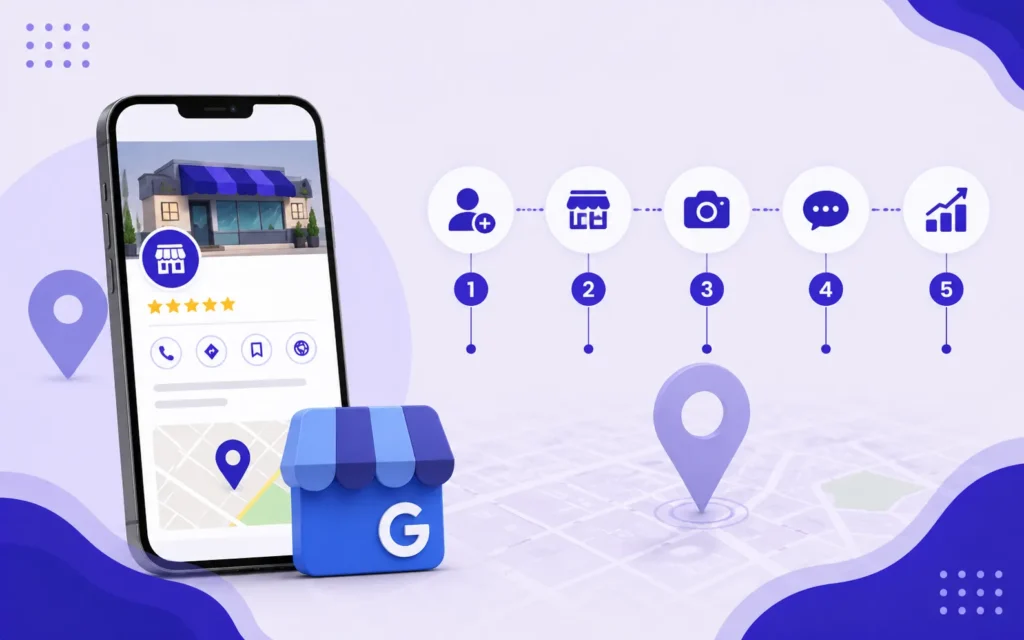
Claim and Verify Your Profile
This is the non-negotiable first step. Do not move to any other optimization until verification is confirmed, as unverified profiles are largely invisible in local search results.
- Go to business.google.com and sign in with the Google account that will manage your business profile permanently
- Search for your business name. If an unclaimed listing exists, click “Claim this business.” If not, click “Add your business to Google.”
- Enter your exact business name as it appears on your signage and legal registration. Do not add keywords, location names, or descriptors that are not part of your actual trading name.
- Choose your primary business category. Select the most specific category available. “SEO Agency” outperforms “Marketing Agency” for SEO-related searches. “Pakistani Restaurant” outperforms “Restaurant.”
- Add up to nine secondary categories covering all services you offer
- Select whether you are a storefront business, service area business, or both
- Complete the verification process. Choose phone or email verification if available for fastest results. Postcard verification takes 5 to 14 days.
- Do not proceed to optimization until verification is confirmed. Changes on an unverified profile may not appear in search results.
Complete Every Profile Section
Google uses profile completeness as a relevance signal. Every empty field is a missed opportunity to tell Google what your business does, where it operates, and who it serves.
- Write a business description of 250 to 750 characters that clearly states what you do, who you serve, and where you are located. Include your primary service keyword and city name naturally.
- Add your complete business address formatted exactly as it will appear on your website and all directory listings
- Add your primary phone number formatted consistently (e.g., 0329 2997093 for Pakistan, +1-704-555-0100 for US). This format must match everywhere your number appears online.
- Add your website URL. Link to your homepage or your primary service page, not a social media profile.
- Set accurate hours for every day of the week including whether you are open on Fridays, Saturdays, and Sundays
- Add special hours for upcoming public holidays, Eid dates, or any planned closures
- Add your opening date. Newer businesses benefit from displaying their launch to set expectations for searchers.
- Add your service area if you serve customers at their location. List every city you actively serve.
- Enable messaging if you want customers to contact you directly through your GBP profile
Add Services with Descriptions
The Services section is one of the most commonly skipped parts of a GBP profile and one of the most impactful for matching your listing to service-specific queries. Add every service individually, not as a single combined entry.
- Navigate to the Services section of your GBP profile
- Add every individual service your business offers as a separate line item
- Write a 100 to 200 character description for each service that includes relevant keywords naturally
- Add pricing where applicable. Profiles with pricing information receive higher trust signals from searchers comparing options.
- Group related services under category headings where the interface allows
Upload Photos
Profiles with photos receive significantly more clicks, calls, and direction requests than those without. Upload a minimum of 10 photos at launch covering every category below, then add new photos monthly to keep the profile active.
- Upload your business logo in square format as the profile image
- Upload a high-quality cover photo representing your business visually
- Add interior photos of your office, workspace, or training area
- Add exterior photos of your building or storefront if you have a physical location
- Add team photos showing the people behind the business
- Add work or service photos: screenshots of results, training sessions, client projects, or product images
- Upload a minimum of 10 photos at launch. All photos should be at least 720 x 720 pixels, sharp, and free of text overlays or promotional graphics.
Publish Your First Google Post
Publishing your first post signals to Google that your profile is actively managed from day one. A launch announcement is the most natural starting point and sets the tone for the weekly posting cadence you will maintain going forward.
- Publish a launch announcement post introducing your business, the services you offer, and the city or area you serve
- Include a photo in the post
- Add a call to action: “Call us,” “Visit our website,” or “Book a consultation”
- Keep the post between 150 and 300 words
- Commit to publishing at least one post per week from this point forward. Weekly posting frequency is a positive activity signal in Google’s local algorithm.
Phase 2: Website Local SEO Foundation
Your website must reinforce the geographic signals in your GBP profile. Google cross-references your website content against your GBP listing when assessing relevance and trust. A website that contradicts or ignores your GBP data weakens both. A website that consistently reinforces it strengthens both.
NAP Consistency on Your Website
Your website NAP must match your GBP listing exactly, including formatting. Even a minor difference like a hyphen versus a space in your phone number creates an inconsistency signal that weakens your local authority.
- Add your full business name, address, and phone number to the footer of your website. This NAP block must be formatted identically to how your information appears in your GBP profile and every directory listing.
- Create a dedicated Contact page that includes your NAP, a Google Map embed showing your location, your business hours, and a contact form or direct email address
- Ensure your phone number is clickable (using a
tel:link) on mobile so users can call directly from the page - Do not use an image of your address or phone number. Text format is required for Google to read and index NAP data correctly.
On-Page Local SEO for Core Pages
These on-page elements tell Google which city and service your pages are most relevant for. Every page that is missing a city name in its title tag is a page leaving local ranking potential on the table.
- Update your homepage title tag to include your primary service and your city. Example: “SEO Agency in Bahawalpur | She Earn”
- Write a homepage meta description that includes your city name, primary service, and a clear value proposition, under 155 characters
- Include your city name naturally in your homepage H1 heading
- Add a “We serve [city name]” or “Based in [city name]” statement prominently on your homepage
- Update all service page title tags to follow the format: “[Service] in [City] | [Business Name]”
- Write unique meta descriptions for every service page
- Include internal links between your service pages using descriptive anchor text
Create Dedicated Location Pages
A single homepage mentioning your city is not a location page. For each city you want to rank in, you need a standalone page with unique content written specifically for that market. Generic content duplicated across multiple city pages provides no local SEO value.
- Create a dedicated page for every city you target. A business serving Bahawalpur, Karachi, and Lahore needs three separate location pages, not one page listing all three cities.
- Write unique content for each location page. A page that simply swaps the city name while keeping identical body text provides no local SEO value and may be treated as duplicate content.
- Each location page should include: city-specific service description, local context relevant to that market, your contact information with local phone number if available, a Google Map embed, customer testimonials from clients in that city where possible, and a clear call to action.
- Set the URL slug to match the pattern used across your site. Example:
/seo-services-in-bahawalpur/ - Link to each location page from your main navigation or services page
Install LocalBusiness Schema Markup
LocalBusiness schema tells Google your NAP, hours, and service area in structured data format it can read with certainty, reinforcing everything already on your GBP profile and website pages. Install it on your homepage as a minimum and verify it using Google’s Rich Results Test.
- Add LocalBusiness schema markup to your homepage. This structured data tells Google your business name, address, phone, hours, service area, and business type in a format it can read with certainty.
- Use Google’s Rich Results Test tool to verify your schema is implemented correctly after adding it
- If you use WordPress, plugins like Rank Math or Yoast SEO include built-in local schema tools. If you manage your site manually, use JSON-LD format and add it to the
headsection of your homepage. - Add opening hours, price range, and accepted payment methods to your schema where applicable
Technical Website Health Checks
Technical issues are silent ranking suppressors. A site with indexation errors or a failing mobile speed score will not benefit from any other local SEO work until these are resolved. Complete these checks before moving to Phase 3.
- Verify your site is indexed by searching
site:yourdomain.comin Google. All key pages should appear. - Connect your site to Google Search Console and submit your XML sitemap
- Connect Google Analytics 4 to track organic traffic from local search from day one
- Run your site through Google PageSpeed Insights and ensure your mobile score is above 50. A failing mobile speed score suppresses local rankings.
- Verify your site loads over HTTPS. An HTTP site without SSL is a trust and ranking liability.
- Test your site on a mobile device. Confirm text is readable without zooming, buttons are tappable, and the page loads in under 3 seconds on a standard mobile connection.
Phase 3: Citation Building and NAP Consistency
Citations are any online listing of your business name, address, and phone number. Google cross-references citation data across the web to verify that your business is real and operating at the stated location. Consistent citations across authoritative directories strengthen your local prominence score. Inconsistent citations weaken it.

Priority Citations for Pakistan Businesses
Start with the directories that carry the most weight for Pakistani local search. Complete each one using identical NAP formatting before moving to the next. Consistency matters more than volume.
- Google Business Profile (completed in Phase 1)
- Facebook Business Page: create a business page with your complete NAP, business hours, website link, and profile photo matching your GBP listing
- Bing Places for Business: claim your free listing at bingplaces.com using the same NAP as your GBP profile
- LinkedIn Company Page: essential for B2B service businesses and agencies. Complete all sections and add your website URL.
- Rozee.pk: relevant for service businesses and agencies in Pakistan
- PakistanYellowPages.com: submit your business with complete NAP and category selection
- Locally.pk: growing directory for Pakistani local businesses
- Local chamber of commerce listing for your city
- Industry-specific directories relevant to your business category
Priority Citations for US-Targeting Businesses
For businesses targeting US city markets, these directories form the core of your citation foundation. Each one feeds into Google’s local authority signals and several also feed data to downstream aggregators that expand your citation footprint automatically.
- Google Business Profile (completed in Phase 1)
- Yelp: claim or create your listing at biz.yelp.com
- Bing Places for Business
- Apple Maps Connect: submit at mapsconnect.apple.com
- Facebook Business Page
- Better Business Bureau (BBB): relevant for establishing trust in US markets
- Foursquare: feeds into dozens of downstream directories and data aggregators
- City-specific business directories for each US city you target
NAP Consistency Rules
These rules apply to every citation you build and every existing listing you update. A single inconsistent directory entry can create a conflicting signal that weakens the authority of all other consistent listings.
- Use the exact same business name spelling across every listing. If your GBP profile lists “She Earn” do not list “ShEarn” or “She Earn Digital” anywhere else.
- Use the exact same phone number format across every listing
- Use the exact same address format including spelling of street, area, district, and city
- Do not use different phone numbers for different directories. One consistent number across all listings is the correct approach.
- If you change your address, phone number, or business name at any point, update every citation immediately
Audit Existing Citations
Before building new citations, check whether your business already has existing directory listings that contain incorrect or outdated information. Correcting inaccurate existing citations is more impactful than adding new accurate ones while the old ones remain conflicting.
- Search your business name in Google and check the first two pages of results for any existing directory listings
- Search your phone number in Google to find any listings using an old or alternative number
- Claim and correct any existing listings that have inaccurate information before building new ones
- Use the free version of Moz Local or BrightLocal to identify duplicate or inconsistent citations at a broader scale
Phase 4: Reviews, Content, and Ongoing Maintenance
Phases 1 through 3 are primarily one-time setup tasks. Phase 4 is ongoing. The businesses that maintain strong local rankings are those that treat Phase 4 as a permanent part of their operations, not a campaign with an end date.
Google Review Generation
Reviews are a direct local ranking factor and the most visible trust signal on your profile. Building a consistent review generation process from the start produces compounding results over time. Set this up as a system, not a one-off campaign.
- Generate your direct Google review link from your GBP dashboard and save it
- Send personal review requests via WhatsApp to your first 10 existing clients or contacts who know your work, each with the direct link
- Add a review request step to your project completion or client offboarding process so every new client is asked automatically
- Create a QR code linking to your review page for use in physical materials, receipts, or your office
- Respond to every review within 48 hours. Positive reviews get a personal thank-you mentioning the specific service and location. Negative reviews get a professional acknowledgment and an offline resolution offer.
- Target a minimum of 2 to 5 new reviews per month from launch. Review recency is a ranking factor. Consistent monthly additions outperform an early burst followed by no activity.
Local Content Publishing
Locally relevant content on your website and GBP profile reinforces your geographic signals and builds the topical authority Google uses to determine which businesses deserve local pack visibility over time. Generic content that could apply anywhere provides no local differentiation.
- Publish at least one locally relevant blog post per month targeting a city-specific keyword. Examples: “best time to invest in SEO for Bahawalpur businesses,” “how Lahore restaurants can use local SEO to get more walk-ins,” or “what Charlotte small business owners should know about Google Business Profile.”
- Write content that references local context: local landmarks, local business conditions, local events, or local customer situations. Generic content that could apply to any city provides no local SEO differentiation.
- Add internal links from every new blog post to your relevant location service pages using descriptive anchor text
- Publish at least one Google Post per week to maintain profile activity signals
- Add new photos to your GBP profile at least twice per month
Backlink and Authority Building
Backlinks from locally relevant sources strengthen your prominence score and signal to Google that your business is recognized within your community. Relationship-based links from suppliers, partners, and local press are the most accessible starting points for a new business with no existing link profile.
- Identify local businesses, suppliers, or partner organizations that could link to your website from theirs. These relationship-based links are among the easiest to earn and carry local relevance signals.
- Submit a guest post to a locally relevant blog, industry publication, or business news site within your first 90 days
- Sponsor a local event, community initiative, or industry gathering. Sponsorships almost always include a website backlink from the event organizer.
- Reach out to local press or business news outlets when you launch. A business launch story in a local publication generates a backlink with strong local relevance.
- List your business in any industry association or professional body directories relevant to your category
Monthly Maintenance Actions
Local rankings are maintained through consistent ongoing activity, not a one-time setup. Run through this list every month without exception. Businesses that skip maintenance for two or three months consistently lose local pack positions to more active competitors.
- Publish four or more Google Posts
- Add two to three new GBP photos
- Request reviews from recent clients and respond to all new reviews
- Check Google Search Console for new crawl errors, coverage issues, or Core Web Vitals failures
- Review GBP Insights for changes in search query terms, profile views, and direction requests
- Verify that your business hours, phone number, and address are still accurate across your GBP profile and website
- Publish one locally relevant blog post
- Check that your top three local competitors have not significantly outpaced you in review count. If they have, increase your review generation activity.
Local SEO Priority by Business Type
Not every business type needs to execute every phase with the same urgency. Use this table to identify which actions will move the needle fastest for your specific business model and to set realistic expectations for your local pack timeline.
| Business Type | Highest Priority Actions | Expected Time to Local Pack |
|---|---|---|
| Restaurant or cafe | GBP optimization, photos, reviews, weekly posts | 2 to 5 weeks in low-competition cities |
| SEO or digital marketing agency | GBP optimization, location pages, citation building, content | 4 to 10 weeks depending on city competition |
| Training academy or course provider | GBP, student reviews, locally relevant content, schema | 3 to 8 weeks |
| Professional services (lawyer, accountant) | GBP, website NAP, citations, client reviews | 4 to 10 weeks |
| Home or trade services | GBP service area, reviews, citations, mobile speed | 2 to 6 weeks |
| Retail shop | GBP hours and photos, reviews, in-store QR codes | 2 to 5 weeks |
Local SEO Mistakes New Businesses Should Avoid From Day One
These mistakes are easy to make when setting up local SEO for the first time and costly to undo once they take hold. Each one either triggers a penalty, creates an inconsistency signal, or wastes effort that would have produced better results applied elsewhere. Review this list before completing Phase 1.
Adding Keywords to Your Business Name on GBP
Listing your business as “She Earn SEO Agency Bahawalpur” when your actual business name is “She Earn” violates Google’s guidelines. Competitors can report this and Google can suspend your profile or edit the name back. Use your real trading name and let your category selection, description, and services handle keyword relevance.
Using Different NAP Formats Across Listings
Listing your phone as “0329-2997093” on your website, “03292997093” on Facebook, and “0329 2997093” on GBP creates inconsistent citation signals. Pick one format and use it identically everywhere from day one. Correcting inconsistent NAP across dozens of directories after the fact is far more time-consuming than standardizing it from the start.
Ignoring GBP After Initial Setup
A fully optimized GBP profile that receives no new posts, no new photos, and no review responses for three months is treated as less active than a competitor who posts weekly and responds to every review. Google’s local algorithm rewards ongoing activity signals. Schedule GBP maintenance as a recurring weekly task, not an occasional one.
Building Citations Before Fixing NAP on Your Website
If your website footer shows a different address or phone number than your GBP profile, building 30 citations pointing to your GBP information creates a conflict rather than a reinforcement. Fix your website NAP first, confirm it matches your GBP exactly, and then build citations that consistently reinforce that information.
Targeting City Keywords Without a Dedicated Location Page
A homepage that mentions your city once in the footer is not a location page. For Google to associate your site with local searches in a specific city, you need a dedicated page with unique content targeting that city’s searchers. New businesses serving multiple cities should create location pages early, even with minimal content, and build them out over the first 60 days.
Tracking Your Local SEO Progress
Without tracking, you cannot identify what is working, what needs more effort, or whether your investment is producing results. Set up these tracking tools from day one and check them monthly.
Free Tools to Track Local SEO Performance
Each of these tools measures a different part of your local SEO performance. Used together monthly, they give you a complete picture of whether your visibility is growing, where gaps exist, and which actions to prioritize next.
- Google Business Profile Insights: Tracks profile views, search queries that triggered your profile, direction requests, phone calls, and website clicks generated directly from your GBP listing. Check monthly for trend changes.
- Google Search Console: Tracks organic impressions, clicks, average position, and which pages are indexed. The Performance report filtered by location shows which city-specific queries are generating visibility.
- Google Analytics 4: Tracks organic traffic volume, user behavior on your site, and conversions from organic search. The Acquisition report shows how much traffic comes from organic search versus other channels.
- Manual local pack check: Search your primary service keyword plus city in an incognito browser window monthly. Note your position in the local pack and track changes over time. This is the most direct measure of your local SEO effectiveness.
Full Local SEO Checklist Summary
Use this summary as your master reference. Print it, save it, or paste it into your project management tool and work through it item by item. Every completed checkbox is a local ranking signal added to your profile.
Google Business Profile
Complete every item in this section before moving to the website or citation stages.
- Profile claimed and verified
- Business name matches legal or trading name exactly
- Most specific primary category selected
- Up to nine secondary categories added
- Business description written (250 to 750 characters, city and service keywords included)
- Hours set for every day of the week
- Phone number added in consistent format
- Website URL added
- Service area defined (if applicable)
- All individual services added with descriptions
- Minimum 10 photos uploaded
- First Google Post published
- Messaging enabled
Website Local SEO
Your website must consistently reinforce every signal in your GBP profile. Any mismatch between the two suppresses both.
- NAP in footer matching GBP exactly
- Contact page with map embed, NAP, and hours
- Homepage title tag includes primary service and city
- All service page title tags follow “[Service] in [City]” format
- Unique meta descriptions on every page
- Dedicated location page for every target city
- LocalBusiness schema markup installed and verified
- Site indexed in Google Search Console
- XML sitemap submitted
- Mobile PageSpeed score above 50
- Site running on HTTPS
Citations
Build these in order and use identical NAP formatting across every listing. Quantity matters less than consistency.
- Google Business Profile (Phase 1)
- Facebook Business Page
- Bing Places for Business
- Apple Maps Connect
- LinkedIn Company Page
- 5 to 10 Pakistan or US market-specific directories
- Industry-specific directories
- All citations using identical NAP format
Reviews and Content
These are ongoing actions rather than one-time tasks. Set them up as repeatable processes from the start so they run without relying on memory.
- Direct review link saved and distributed to team
- First review requests sent to existing contacts
- Review request added to project completion process
- Response process set up for new reviews
- First locally relevant blog post published or scheduled
- Monthly Google Post schedule confirmed
Frequently Asked Questions About Local SEO for New Businesses
How Long Does Local SEO Take for a Brand New Business?
A new business that completes Phases 1 through 3 of this checklist within its first 30 days can see local pack ranking movement within 4 to 8 weeks in lower-competition Pakistani cities like Bahawalpur or Multan. In higher-competition markets like Karachi or Lahore, expect 8 to 14 weeks to see consistent local pack positions for primary keywords. The timeline depends primarily on how competitive your local market is and how consistently you generate reviews and post on GBP after the initial setup.
Do I Need to Pay for Local SEO Tools to Get Started?
No. Google Business Profile, Google Search Console, Google Analytics 4, Bing Places, and Apple Maps Connect are all free. The manual local pack check described in the tracking section costs nothing. For new businesses with limited budgets, these free tools are sufficient to execute and track a complete local SEO strategy through the first 6 months. Paid tools like Ahrefs, Semrush, or BrightLocal add efficiency and data depth but are not required to get started and see initial results.
Should a New Business Focus on Local SEO or Google Ads First?
For most new local businesses, completing Phases 1 and 2 of this checklist takes priority over any paid advertising. A fully optimized GBP profile in a lower-competition market can produce local pack visibility within 4 to 6 weeks at no cost per click. Google Ads produces immediate visibility but requires ongoing spend to maintain. The recommended approach for new businesses with limited budgets is to complete the local SEO foundation first, then use Google Ads tactically to generate leads during the period before organic local rankings develop, reducing ad spend as GBP rankings improve.
How Many Cities Should a New Business Target With Local SEO?
Start with one city: the city where your business is physically located or where your primary customer base is concentrated. Build a strong local SEO foundation in that city before expanding. A single well-optimized location produces faster results than a thin presence spread across five cities simultaneously. Once your primary city is producing consistent local pack visibility and review growth, expand by creating dedicated location pages and GBP service area additions for secondary cities. She Earn’s local SEO services cover Bahawalpur, Karachi, Lahore, and Islamabad with strategies built for each market’s specific competition level.
What Is the Fastest Way to Improve Local Rankings for a New Business?
The three actions that produce the fastest local ranking improvements for a new business are: completing and optimizing your Google Business Profile in full (particularly category selection, description, and photos), generating your first 10 to 15 Google reviews from existing contacts within the first 30 days, and ensuring your website NAP matches your GBP listing exactly. These three actions together can produce measurable local pack movement within 3 to 6 weeks in lower-competition markets. Technical fixes and citation building produce results in 4 to 8 weeks. Content and link building compound over 2 to 4 months.
Start With Phase 1 Today
Every week your business operates without a claimed, optimized Google Business Profile is a week competitors with weaker offerings but stronger local SEO are capturing customers who were searching for exactly what you provide. Local SEO for new businesses is not a competitive advantage reserved for large companies with large budgets. It is a free and accessible set of actions that any business owner can begin today.
Complete Phase 1 this week. Move to Phase 2 immediately after. By the end of your first month, your local SEO foundation will be stronger than the majority of your local competitors who have been in business for years but never prioritized it.
If you want professional help executing this checklist faster and with market-specific strategy for your city, the She Earn team is available to build and implement your local SEO foundation. If you want to learn the process and manage it yourself, She Earn’s SEO courses include full local SEO training with step-by-step instruction built for the Pakistan market.